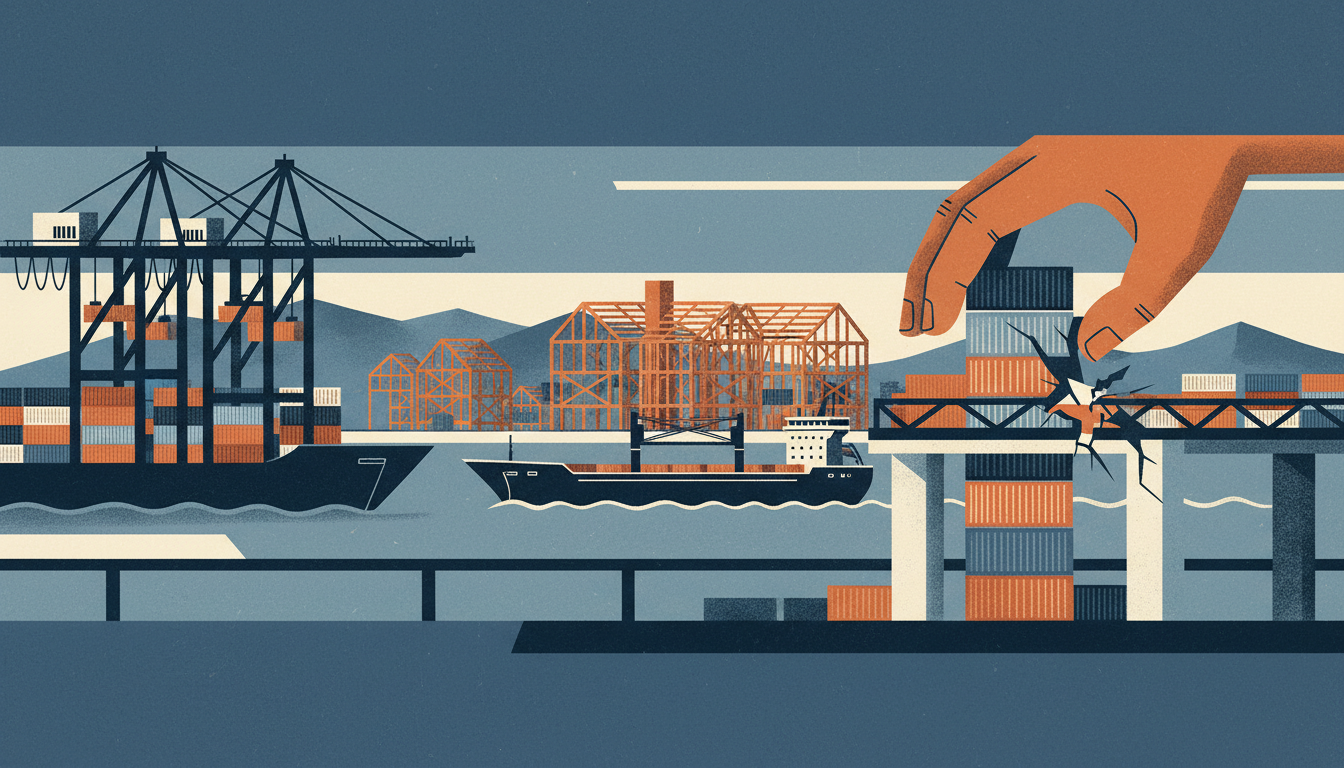
The possible collapse of the Canada-United States-Mexico Agreement (CUSMA) could result in the loss of 102,000 Canadian jobs and cost the country $271 billion CAD in GDP by 2035, according to recent reports from CBC News and Scotiabank's economic analysis.
Trade talks continue ahead of a looming August 19, 2026 deadline, which could introduce new 50 per cent tariffs on a range of Canadian exports to the U.S., threatening economic stability in provinces heavily reliant on cross-border trade.
Manufacturing centres in Quebec and Ontario stand to suffer the greatest impact from a CUSMA breakdown, particularly in auto, wood product, and metal manufacturing sectors, the reports said. These sectors form the backbone of employment in these provinces, raising concerns among policy makers and industry leaders alike.
Scotiabank's macroeconomic analysis forecasts a potential contraction of up to 1.9 per cent in Canada's GDP under a severe breakdown scenario, with unemployment rising above seven per cent. While described as a "low probability event but with high economic costs," the scenario poses significant risk to the economy.
One analysis noted that the implications of a failed renegotiation extend beyond immediate job losses to increased inflation and decreased real disposable income, which could exacerbate economic strain for Canadian households and businesses.
The U.S. economy would face even larger consequences, with an estimated loss of 214,000 jobs and $1.04 trillion USD in GDP by 2035, according to CBC News. However, Canada's smaller economy would feel disproportionately severe inflationary pressures and income contraction, underscoring the integral role CUSMA plays in stabilizing its trade-dependent regions.
Ontario, New Brunswick, and Quebec are identified as most vulnerable to tariff impositions, while provinces such as Saskatchewan, Alberta, and Newfoundland and Labrador face less immediate risk due to lower export exposure to the U.S. market.
Federal and provincial governments are engaged in intensified negotiations aimed at avoiding the tariff deadline. Officials emphasize that timely agreement renewal is necessary to protect jobs and maintain integrated supply chains that have grown under CUSMA since its inception.
Industry and business councils representing Canadian exporters have echoed this urgency. Stakeholders argue that failure to maintain the agreement could destabilize established North American supply chains, with ripple effects on communities dependent on cross-border commerce.
Scotiabank's economic modeling also stresses that successful renegotiation could create up to 98,000 jobs in Canada and add 137,000 jobs in the U.S., highlighting the potential benefits of preserving and potentially upgrading the trade framework.
As the August 19 deadline approaches, attention focuses on whether negotiators can reach a consensus that averts tariffs and preserves economic growth prospects. Canada's federal government continues to coordinate efforts with provincial counterparts and business leaders to advocate for the agreement's renewal, underscoring its importance to the country's economic future.